History
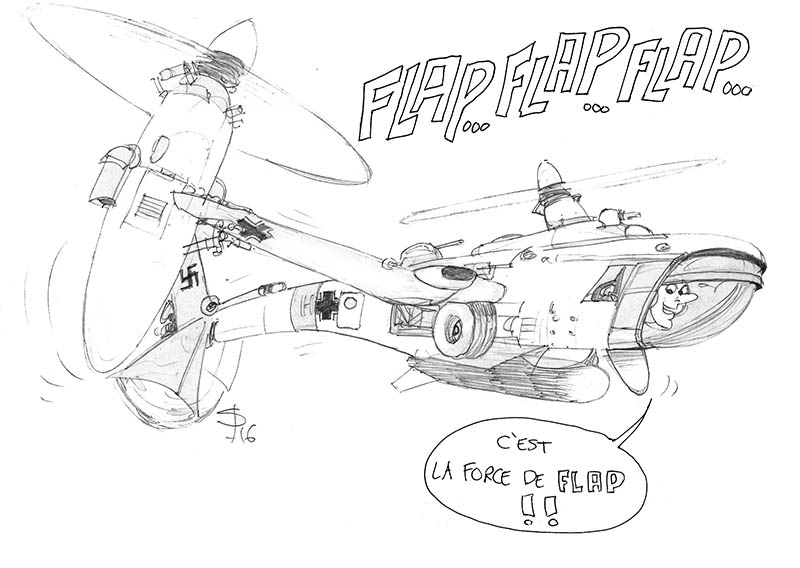
The need was felt within the O.K.L. (OberKommando Der Luftwaffe) for an aircraft that was part plane, part helicopter - powerful, fast and able to operate anywhere...
Oberstgruppenführer Schmit summoned Dr. Ferdinand Lippisch - who had successfully launched the Fledermaus - to speed up the production of a first prototype. The war in Eastern Silesia had "dragged on" for too long. Supplying the troops at the front was a problem... Hitler, who had little interest in modern technology and swore by conventional weaponry, agreed...
Developed by engineer Heinrich Dorthmund in 1946, and the successor to the "Dorthmund II", which crashed on the proving ground, killing the pilot. After the success of the first prototype, the "II" model showed its limitations in terms of underpowering and lift.
The "III" benefited from two new Maybach engines and a more advanced tailplane. The rear rotor was increased from three to five blades. The gyro-stabilized rear wing, coupled to the rotor, was intended to provide a much smoother transition from vertical to horizontal flight and... and vice versa.
Large, all-terrain wheels and new Armsthrum long-travel shock absorbers - which fold under the wings during flight - were to contribute greatly to improved landings in rough terrain...
The crew comprised four men. A pilot, a navigator, a manipulator and a turret gunner. The dorsal turret was armed with two 14.5mm MG 313s for protection, as well as a second, remote-controlled 7.65mm binomial machine gun that could be operated by the gunner as well as the navigator...
18 m long, with a wingspan - excluding blades - of 22.10 m, it could reach speeds of up to 650 km/h thanks to its two 700 hp engines...
Nicknamed "Dhort" or "Maikä" (for Maikäfer - German for cockchafer - the open horizontal cockpit doors are reminiscent of the insect's antennae) by crews. Highly mobile despite its imposing wingspan, the aircraft proved to be extremely smooth and maneuverable despite its 28-ton weight. Powerful take-off and top speed ensure rapid intervention on site and rapid clearance (like the raids carried out by the American "Hueys" during the future Vietnam War)...
The naval version of the aircraft carries a 1,000 kg electronic homing torpedo which, once ejected, is capable of flying autonomously for kilometers to its target. A cruise missile is used in other weapons. But it can also carry containers and other loads...
In 1948, 2,315 examples were built, operational on all fronts. Some were assigned to civil protection...


