The Woods
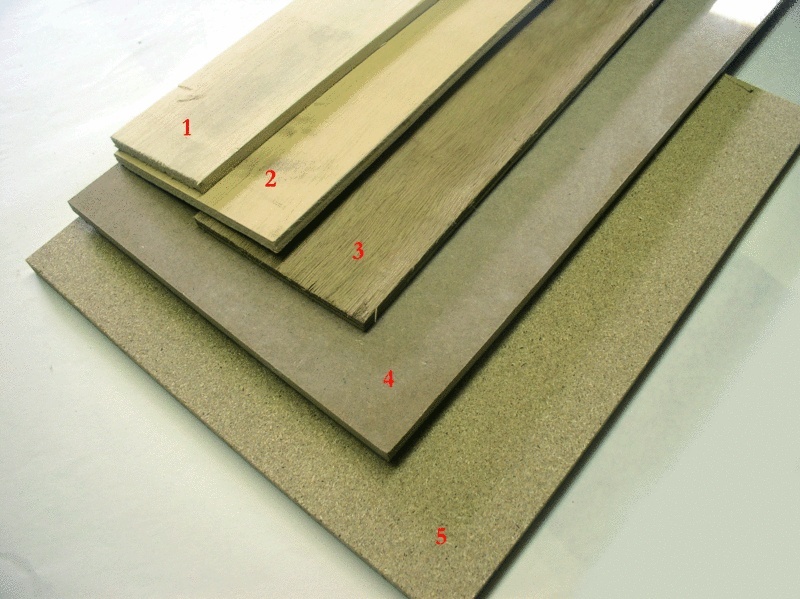
Most of the commercially available woods are as follows:
- Balsa wood: This lightweight wood is very easy to work with—cutting, carving, sanding, filling, painting, etc. Its main drawbacks are its fragility and cost.
In our line of work, we use it primarily for decorative projects... - Marine/water-resistant plywood: This reinforced laminated wood product is specifically designed with the following characteristics in mind: minimal or no warping when exposed to moisture, and very high mechanical resistance to torsion and bending over the long term.
We primarily intend this material for two uses: as a base for decorative finishes or for use with water-based materials (plaster, coatings, resins, etc.), as well as for providing greater structural strength.
The second use is for creating sanding blocks that are perfectly flat and straight, in a wide variety of thicknesses, with high-quality double-sided tape ensuring easy replacement of the sandpaper. The main drawback of marine plywood is its cost. - Standard plywood: It has the same mechanical properties as marine plywood but lacks the latter's water resistance. Its main advantage is its very affordable price...
- M.D.F., or "Medium": the ideal material for all modeling and high-precision work. It consists of wood flour (with a particle size close to one micron) that has been compressed and bonded. It cuts and shapes easily with the proper tools. It works very well with all types of polyester body filler as well as every conceivable microporous primer (except water-based ones, of course).
It is primarily intended for use as a structural base for framework (such as a spaceship) or for creating depth in scenery (a corridor with forced perspective, etc.). Another major advantage is its very affordable price... - Particleboard: This widely used material has only one advantage—its very low cost. Other than that, it has nothing but drawbacks across the board. It is highly susceptible to ambient humidity, cuts lack precision, the cut edges must be filled with putty, it is brittle, and it offers no mechanical strength for basic joints...
