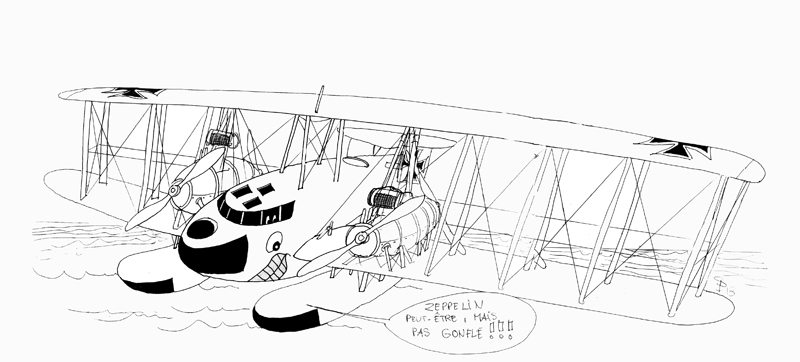
"Zeppelin maybe, but not swollen !"
The German navy's interest in seaplanes did not wane with the destruction of its RML.1s; on the contrary, naval authorities actively pursued the development of seaplanes for use in naval warfare...
The reason for the increased emphasis on seaplanes was that British aircraft had been very successful in attacking German airships. This led to a standing order that airships should remain above 13,000 feet, which precluded their use as low-level submarines, harbor and mine physionomists. Taking this into account, Admiral Philipp recommended the development and evaluation of vulnerable minus-R seaplanes and by seaplane category. As early as December 1916, Admiral Philipp listed the advantages of airplanes over airships, as follows: they could fly faster, carry greater defensive armament, did not require huge hangars, could be prepared for flight in a fraction of the time, used fewer personnel and were cheaper to build...
On December 26, 1916, a report from Oberlt.zSMans, who had just returned from an inspection of the R Dornier-flying-boat, and with the remark that Luftschiffbau Zeppelin is to submit a new proposal to meet the above reconnaissance requirements. It should be noted that, during the war, only two companies, Staaken and Dornier, both part of the Zeppelin group, delivered R-flying-boats to the navy...
Staaken proposed a seaplane version of the Staaken R.VI, designated Staaken L, which was ordered by the German navy on February 15, 1917. After completion in August 1917, the Staaken L, fitted with a standard R.VI. mobile chassis, was transported to the test company's seaplane site in Potsdam, where the floats were fitted. On September 5, 1917, it was launched for the first time and promptly made two short flights. Modifications made during flight tests included replacing the narrow four-blade propellers with standard two-blade ones, adding a central fin to improve directional stability, and reinforcing the float strut structure. On November 12, 1917, the Staaken L took off from Potsdam for a delivery flight but, due to engine failure, was forced to land at Saaler Bodden, some 40 km east of Warnemünde. After repairs, the Staaken L was delivered to the Navy on November 14, 1917...
A wooden shed was designed and built by Firma Carl Tuchscherer in 1917 at the Staaken L house. Built above on stilts, the shed was unique and the door was only 27.5 meters wide. A large door capable of withstanding high winds and EIG would have been difficult to install and maintain. So, to keep the door small, it was decided to put the plane in the hangar sideways, using a new technique. Experiments had shown that it was impossible to place a plane in a hangar on its side, even in the slightest wind and wave conditions. Consequently, Tuchscherer proposed and built a pivot, a floating jetty extending at right angles to one side of the hangar opening. The aircraft's left float was secured to the floating jetty. Next, the jetty was swung around, its pivot-side end turning the aircraft onto the raw side of the hangar opening, as it concluded a 180-degree arc. The hangar trusses were capable of supporting a load of 12,000 kg, allowing the L Staaken to be lifted for repairs to the floats. A second, much larger hangar capable of housing four R-avion centers was under construction at the end of the war...
The Staaken L crashed at Warnemünde on June 3, 1918, killing the pilot, Lieutenant Haller and crew. Very little is known about the results of the Staaken L's evaluation tests. It was not as stable on the water as the Dornier R seaplane. The wingtips would touch the water at a 7-degree heel, whereas the seaplane needed a 14-degree heel. Nevertheless, it was a proven concept that Staaken had to be built in quantity, and could be produced in less time than the metal Dornier seaplane. Six more Staaken L seaplanes were ordered by the navy...
Specifications. Manufacturer: Flugzeugwerft G; mbH, Staaken, Berlin. Engines: Four 260 H.P. Mercedes D IVa. Normal 0 21 MicrosoftInternetExplorer4 Wingspan, 42.2 m. Length, 22.2 m. Height, 7.38 m. Propeller diameter, 4.4 m. Maximum speed, 125 km/h. Ceiling, 2500 m...


