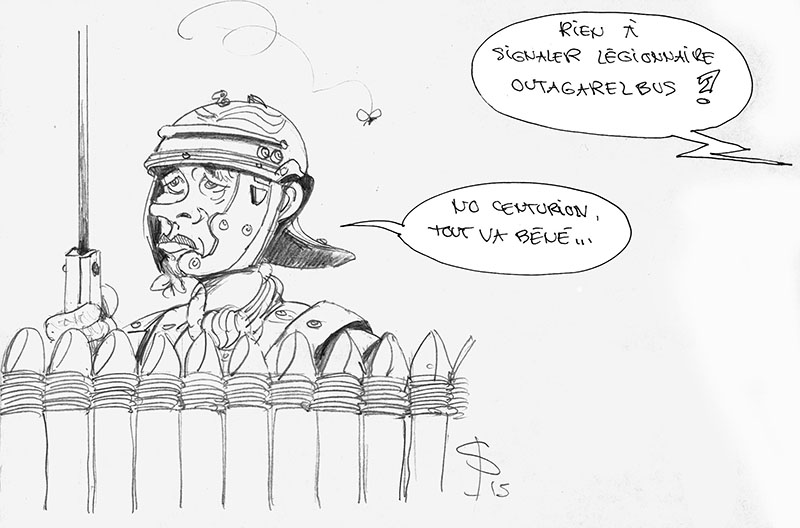
"Anything to report, legionnaire whereyouparkedthebus ?" "No centurion, nota bene..."
The Roman camp
Roman legions on campaign set up an entrenched camp at every halt, even if only for a single night. It seems that this practice was introduced after Camille's reform, but unfortunately there is nothing to date it formally. In addition to their kit, each legionnaire carried two square wooden stakes, ending in a point at each end and measuring approximately 1.70m in length. These were to be planted (at an average depth of 30cm) at the top of the earthen embankment and tied together at ground level and at the top to form a palisade (vallum), giving the camp an entrenched perimeter of around 1,760 meters (580m x 290m) or a surface area of 16.82 hectares.
The earthen levee (agger) was made up of earth excavated from the ditch (fossa) dug in front of it. The ditch was 4.50 m wide and 2.25 m deep. As for the levee, its base was 5.50m wide and 1.25m high, with a 2.75m-wide summit. The outer surface of the earthen levee was covered with clumps of grass removed during the digging of the ditch, making the sloping surface slippery for any enemy, and securing the countervallation to avoid the risk of a landslide.
The camp site was chosen by a detachment of scouts led by a tribune. The officer always took care to choose a flat spot, as uncluttered as possible and close to a watering place and meadows providing fodder for the horses and cattle used in the train. The men under the command of the tribune survey the terrain. The location of the legate's tent, thepraetorium, the altar, the tribune and the ensign tent are determined first. Next, the two main perpendicular axes (cardo and decumanus) are drawn, followed by the secondary axes that define where the tents will be set up. We finish by setting the perimeter and indicating the locations of the 4 gates at each end of the main roads. The camp plan is a common standard in the Roman army, so a messenger from any unit knows immediately where he has to go.
Despite the imposing nature of the task, this type of temporary camp was completed in just two hours. When the legion arrived on site, everything was marked out with coloured stakes. With 3,000 men working in teams of two (one digger, one shoveller), the volume of earth to be treated per team was only around 3m3. Meanwhile, 1,500 to 2,000 men cleared at least 50m of trees and bushes around the perimeter of the camp, and prepared the defences:cervibranches around the camp, and the system for closing the entrances. All that remained was to erect the 800 or so tents that would house the entire troop.
The Roman centurie, made up of 80 legionnaires, is divided into 10 groups, the contubernium (plural: contubernii) made up of eight men, the contubernalis. Each contubernium was housed in a tent, the papilio, and provided with cooking utensils, a millstone for making flour and various tools (shovel, dolabra, slicer, etc.). Theoretically, a mule is allocated to each contubernium. Each centurie therefore had 10 tents plus one reserved for the centurion's use.
Attacking such a device was tantamount to suicide. The clearing of the undergrowth ruled out a surprise attack. In addition, the attacker had to make his way through the cervi, down into the ditch and then climb up the agger made slippery by the addition of sods, attempt to cross the 1.40m-high palisade and find himself facing the legionnaires' shields. At night, a sentry was posted every 10 to 15 meters. In addition, every 50 meters, posts of sleeping men in arms, ready to intervene, reinforced the system. The most important thing was that, thanks to this standard plan and to training, in the event of an alert every man knew exactly where he had to be and what he had to do. The same applied to the units placed in reserve, who, on a simple order, knew exactly what their task was and where they were to go.
Life in the camp is pretty rough. We rise at dawn to gather in front of the centurion's tent, then the centurions go to greet the tribunes, who in turn go to greet the legate. The legate then passes on his orders for the day to the tribunes, who repeat them to the centurions. The officer on duty, the tessarius, writes down the day's password, as well as the duty roster (guards, chores, punishments, etc.) on a tessera. The legionary's life was regulated by bells announcing wake-up calls, soup, chores, etc. Guards were posted near the legion's ensigns and the altar where the statue of the emperor was enthroned, as well as in front of the prison. Patrols were sent out, men were assigned to carry messages, and others were assigned to watch over horses and pack animals. Men were sent out to fetch wood (ad lignum), water for bathing (ad aquam balnei), etc. Legionnaires who specialized in technical tasks (leatherworking, blacksmithing, etc.) were exempt from chores: these were the immunes. Training takes place in an enclosure outside the camp, the campus.
By Sextus Ahenobarbus of Nettus.


