The Panzer III - Sdkfz 141 - was the main tank of German units in autumn 1941. The Panzer III ausf J arrives in March 1941 for Operation Barbarossa. Too light, too lightly armed. The J's 50mm front armour, inclined at a height of 69°, could only stop projectiles of up to 37mm, and the design of the machine was not conducive to the ricochets of armour-piercing shells. The 5cm KwK L/42 gun (for the J) - range 2,100m. Pierces 43mm of armor at 500m. Insufficient for the T34's 75mm frontal armor. Replaced by the more powerful L/60.
Technique adopted in Russia: one panzer fires frontally, while two others attack at short range from the flanks or rear. In general, Russian tanks fall back as soon as they come under fire, even with lighter weapons...
Maybach HL 120 TRM engine. 40km on road, 20 off-road. Not as fast as the T34.
Will be present on all fronts until the end of the war, despite the end of production in February 1943...
The 24th Pz div.
From the 1st cavalry division, which fought in the Netherlands on May 10, 1940, on the Somme on June 7, and against the Saumur cadets from June 19 to 21 - for which it paid tribute by letting its prisoners go home for their bravery. She ended her campaign at La Rochelle on June 23.
In 1941, it fought alongside Guderian's Panzergruppe 21 (the only motorized formation). Captures 9,300 prisoners, 39 artillery pieces and 80 trucks on October 18 & 19. Withdrawn from the front before winter, surrendered its 17,000 horses to the infantry.
Becomes 24th Pz div. November 28, 1941. Training in France at Coètquidan & Mailly camps. Departs for the Eastern Front in May 1942.
Leader: Major General Bruno Ritter von Hauenschild.
Equipment: 181 tanks (never replaced).
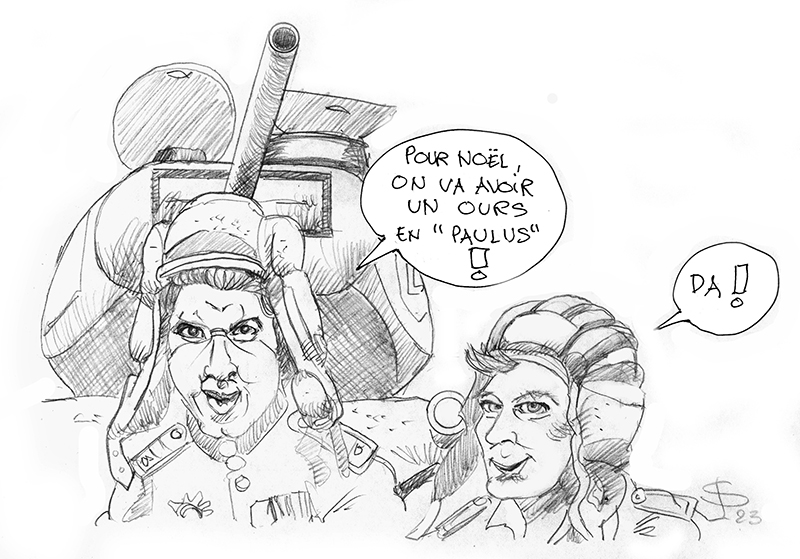
In November 42, positioned to the far north of Kessel, it was encircled at Stalingrad by General von Paulus's 6th Army, which, not wishing to disobey Hitler's orders*, did not order a retreat and surrendered. The result was the encirclement of 250,000 soldiers. 45,000 sick and wounded were evacuated by plane before the surrender, and around 100,000 died in the fighting, killed by the enemy, from hunger and cold, epidemic disease or other causes. Over 90,000 were taken prisoner. An estimated 10,000 returned years later, but the figures are inaccurate and difficult to verify...
Destroyed in January 1943. 1,500 prisoners. Reformed on January 17, 1943 in France.
* Other sources confirm that Hitler's stubbornness in sacrificing Paulus enabled him to gather large forces on other fronts, while immobilizing a large part of the Red Army in front of Stalingrad...


