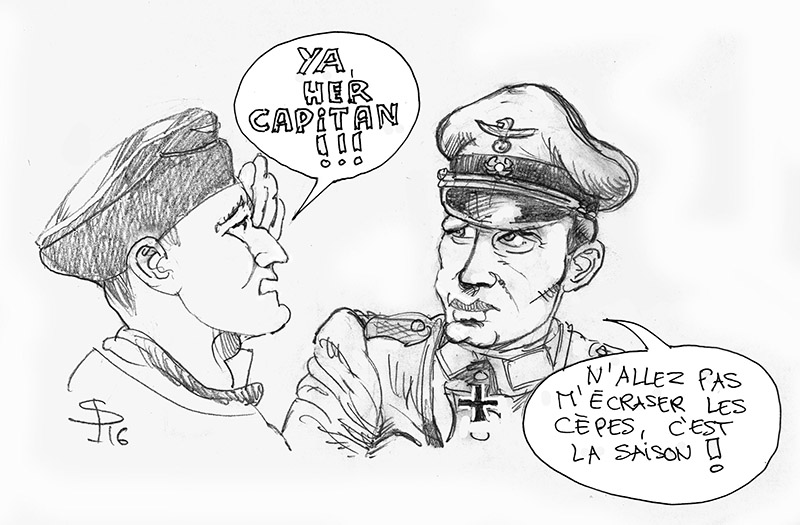
"Don't go crushing my porcini mushrooms, it's in season !"
JAGDPANTHER - Sdkfz 173
One of the most "beautiful" fighting machines of the Second World War...
In August 1942, the German High Command decided to adapt the excellent 8.8 cm Pak 43 cannon to a Panther chassis, then in use on the Nashorn - a self-propelled artillery vehicle built on a Panzer IV chassis.
Begun at Krupp in October 1942, the project was then transferred to Daimler-Benz, who manufactured the Panther from summer 1943...
Crew of 5 men - 9.96m long - 3.42m wide - 2.71m high for a weight of 46T. The Maybach HL230-P30 engine ensures a speed of 55km/h.
57 shells - one MG34 casemate machine gun - 1 grenade launcher.
1 Sfl Z1A periscope sight for the aimer - 2 for the outfitter - 1 Sf1 4Z for the tank commander.
Radio sets are the FU 15 & FU16 used by the artillery. Command vehicles are equipped with long-range FU 8s.
...In May 1943, production shifted to MIAG - Daimler encountered space problems... At the end of the month, roof, glacis and rear deck armor were reduced to 16mm to lighten the vehicle (the front end remained at 100-60mm)...
The barrel is shifted slightly to the right, reducing the horizontal travel by 12° on each side. End-of-series models (September 44) will benefit from a bolted shackle to facilitate barrel removal.
Zimmerit fitting was also discontinued on all vehicles in September 1944.
The 1st prototype came out in October 1943. The final version in December 1944, with rearranged rear tooling, flame-reducing exhaust pipes and a raised rear fan to heat the crew compartment.
Production runs from January 1944 to April 1945... But then again... It's all relative... Steelmasters magazine - not to quote it - gives different figures in its n°9 and the thematic n°2... Where we go from 415... to ... 72 !!! Take your pick!
*****
A family member told me - a long time ago - of his encounter with a Jagdpanther while commanding Shermans in the Normandy bocage. Well concealed in the thicket, it targeted the column, destroying one tank after another... They only saved themselves by managing to get around it and destroying a caterpillar to immobilize it...
The Second World War was without doubt the greatest conflict known to mankind, mobilizing over 100 million combatants and killing around 60 million, the majority of them civilians.
It was the greatest ideological war in history.
The sum total of the damage has never been quantified with any certainty, but it's fairly certain that it exceeds the sum total of all human conflicts since its inception...


