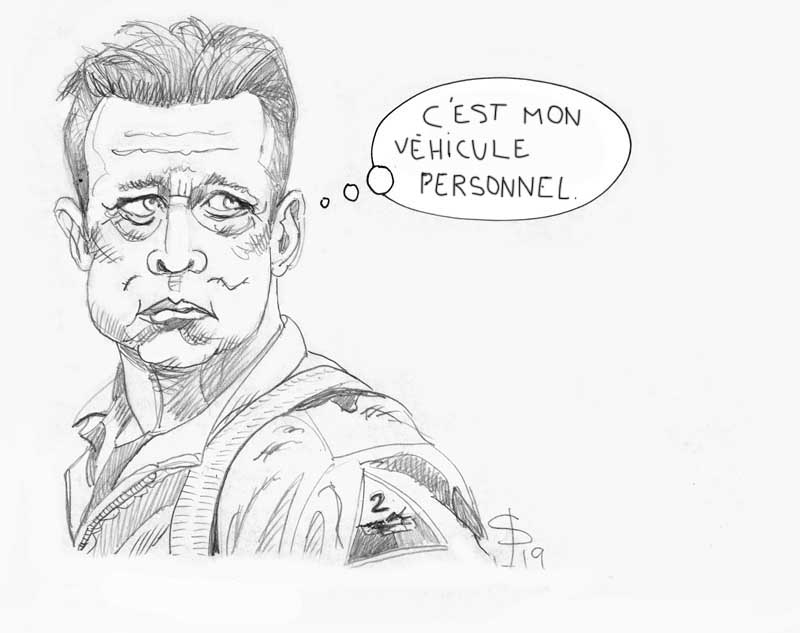
"It's my personnal car !"
The Sherman M4 A3 E8 (easy eight).
The most powerful in terms of armament and equipped with the HVSS suspension system. This addition improved the vehicle's ground pressure, with a wider track. The new models were also complemented by a larger-caliber 76mm cannon, with high velocity, better rate of fire and greater accuracy; a relatively late addition to the war effort, bringing the armament closer to the capabilities of the German 75mm cannon.
Despite the increased armor compared to the M4 Sherman, the "Easy Eight" remains a very fragile target, and will be easily destroyed if left exposed to enemy fire.
The hulls were, for the most part, welded (as opposed to molded) and fitted with Ford GAA V8 gasoline engines. Its strong point is its excellent mobility. It accelerates very quickly over any terrain, and loses little energy in turns, making it an ideal flanking tank.
The Ford Motor Company didn't design the Shermans, but it did build them - albeit only 1,690 M4A3s between June 1942 and September 1943. In all, some 50,000 Shermans were built for the war - and the vast majority were built by General Motors and Chrysler.
The relatively rare Ford-built Shermans were equipped with Ford's 450-hp 18-liter GAA V8 engine - originally a V12 derived from the Rolls-Royce Merlin and Allison aviation engines that were supposed to be used in American aircraft. When the Navy rejected Ford's V12 - because it had decided to use radial engines - Ford removed four cylinders and turned it into a tank engine.
Production of the Easy Eights totaled 2,617 in August 1944. A total of 11,424 vehicles with the improved HVSS suspension were produced by Fisher Tank Arsenal and Detroit Tank Arsenal from June 1942 to March 1945. The vehicle is also known as the M4A3(76)W.
At this point in the Second World War, Germany had far superior tanks (albeit fewer in number) and could destroy most American tanks. At the start of the war, the battle was much more evenly balanced; but the Germans continued to improve their tanks, while the Americans did little in this respect. And tank crews, like Fury's, paid a terrible price.
It took part in many post-war conflicts - Korea 1950 to 1953 - right up to the 1965 Indo-Pakistani war. Then improved in 1967 by the Israelis during the "6-day war", who adapted the French 105 AMX 30 and 75 AMX 13 guns to this model, with the help of France.
About Fury...
To be seen as an adventure film. So full of implausibilities that veterans avoided it...
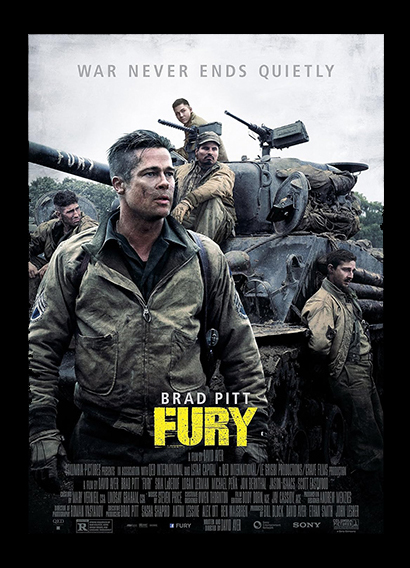
In the film "Fury", U.S. Army Sergeant Don "Wardaddy" Collier (Brad Pitt) commands a tank with a crew of five men in the legendary 66th Armored Regiment of the 2nd Armored Division, as it invades the heart of Germany in April 1945, just days before the Nazi surrender.
If the film were based on a real-life character - and it isn't - Collier wouldn't have driven an Easy Eight. And he wouldn't have fought a German Tiger.
They're all supposed to have fought together - in Fury - since the North African campaign in 1942. If that were the case, Fury would probably have been a much older model - with the old suspension - like an M2 or M4A3, each of which went into production in 1942. But with a 50% loss rate in most mid-WWII tank battles. An older M2 or M4 model that had survived more than three years of combat would have been unheard of. (In fact, only one Sherman tank - a Canadian - is known to have survived from D-Day in June 1944 to May 1945).
The tank used in the film had a Ford engine, but it wasn't an M4 from the North African campaign. It was a more or less cobbled-together M4A2 with HVSS suspension - not a real "easy eight".
The American tanks in the film - ten were used - all came from the Bovington Tank Museum in southern England ("Fury" bears serial number T224875), where the film was mainly shot.
This is also where the filmmakers obtained the German Tiger tank (apparently, the only panzer available for the film!), a relic that was no longer in production in 1945. A dreaded fighting machine, it was criticized for being heavy, cumbersome and oversized.
Just look at the fluorescent green shots (a la Star-Wars!!) fired during tank battles in the film...!
As usual, America puts the spotlight on its "victimized" heroes. As someone once said: "The enemy is a c..., he thinks the enemy is us when it's really him...".
Among other things - the month of April 1945, when the action takes place, is the month when the Americans suffered the fewest losses, the Germans being in full rout and not taking the risk - a whole column of them - of attacking a Sherman tank alone, let alone pushing so hard... Especially with air and ground supremacy for the Allies.
As for the actors, they're all perfect in their roles.


